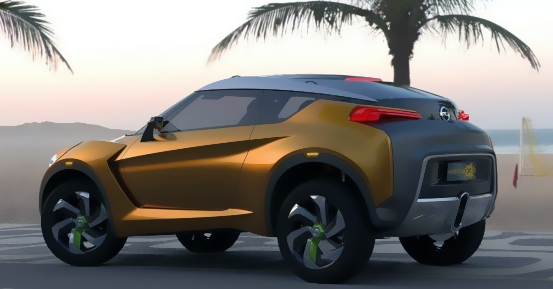
TATA Motors to build electric and hybrid cars on Nano platform

tata-nano-europe2

My Iris reported that TATA Motors has plans to use its Nano platform to build electric and hybrid cars and to produce more high end models.

TATA Group said TATA Motors should target exports of the car in the developing countries like Brazil, China, Indonesia and Russia where the growth rate is over 10%.

The introduction of Nano was compared to that of the Ford Model T, the car that completely revolutionized the automobile industry. Nano is also expected to create a new distinct category in the auto industry – the People’s car.

A true Indian car, Nano has 97% local content. Before Nano, Maruti 800 was the cheapest car in the Indian market priced at around INR 2 million.

Toyota to Boost Hybrid Battery Capacity by 10%

Toyota Motor Corp. will boost hybrid battery production capacity as much 10 percent over earlier plans next year as orders for its Prius model rise, the Nikkei newspaper said.

The automaker aims to increase manufacturing capacity to 1.1 million nickel-metal hydride cells in 2010, the paper said, without saying where it got the information.

Toyota originally planned to boost production capacity by 300,000 batteries from 700,000 a year, the report said. Panasonic EV Energy Co., owned by Toyota and Panasonic Corp., will make the batteries, the paper said.

Toyota increased output of the Prius in Japan this month as orders rose 75 percent since the hybrid went on sale in May.

Honda’s hybrid pricing gambit: the sub-$20,000 Insight

honda-insight

Honda’s much-anticipated Prius fighter may double as a recession fighter.

The Japanese automaker said today that when the 2010 Honda Insight hybrid hits dealer lots in two weeks, it will carry a base price of $19,800. That puts an end to months of speculation over just how much less expensive the new Honda would be than the Toyota Prius, currently the top-selling hybrid in the U.S.

At under twenty grand, the Insight will be the least expensive new hybrid available in the country; even the more feature-laden EX version of the Insight, which includes alloy wheels and paddle shifters, will be under the Prius’ $22,000 starting sticker. By pricing it so low — almost $4,000 less than its own Civic hybrid — yet delivering a car that looks and behaves remarkably similar to the current Prius, Honda is making a risky bet that cost-conscious consumers will be lured to choose its hybrids over non-hybrid alternatives. Meanwhile, with a new far more fuel-efficient 2010 Prius set to hit showrooms in June, the Insight could lose out on buyers who care more about green (as in ecology) than green (as in dough).

Honda apparently has its eyes trained on a broader swath of customers. The Insight, said Dick Colliver, executive vice president for Honda’s U.S. sales arm, “brings the cost of entry for hybrid technology within closer reach of an entirely new car-shopping audience.” The automaker hopes people who otherwise wouldn’t have considered a hybrid will choose the Insight because it’s cheaper to buy and operate than comparable vehicles.

The Insight first went on sale in Japan last month, where it sells for 1.89 million yen ($19,260). So far, 18,000 have been ordered, according to Honda, and 4,906 were sold and registered in February, making it the top-selling hybrid in Japan for the month. The company has said it hopes to sell 200,000 of the vehicles globally each year, with about 90,000 selling in the U.S. during the first 12 months of sales. By comparison, Toyota sold 241,405 of the Prius models in the U.S. last year.

The down economy could put a dent in Honda’s sales plans, however. The value of used hybrids, an important indicator of demand for the vehicles, has slumped considerably as consumers turn to cheaper options. According to research firm Kelley Blue Book, used hybrid prices are down about 25% since last summer, more than any other category of vehicle, and fell 2.5% in February alone.

And while the Insight measures up pretty well against the Prius and even more expensive hybrids on cost, it still is quite a bit higher than fairly efficient non-hybrid competitors such as the Toyota Yaris ($12,205 starting price) and Nissan Versa ($9,990).

That’s a particularly sensitive point considering the relatively low price of gasoline of late. “Demand for fuel efficient vehicles has dropped significantly as more and more consumers base their purchase decision on vehicle transaction price as opposed to fuel economy,” said Juan Flores, director of vehicle valuation at Kelley Blue Book.

When gas is costly, hybrids can more easily justify their cost differential in gas savings. But with the national average for a gallon of go juice at $1.94 (down from over $4 last summer), that savings payoff take a lot longer.

The Nissan Versa, for example, gets 27 mpg in city driving and 33 mpg on the highway, and it costs $9,810 less than the Insight. At current gas price levels, according to one of the niftiest of the many nifty hybrid cost calculators available online, the Honda Insight, which gets 40 mpg city and 43 highway, would save drivers about $315 a year compared to the Versa based on normal driving. That means it will pay for itself in a mere 31 years, or about three times the expected life of the vehicle.

Consumers clearly don’t base all their car-buying decisions on price alone. If they did, it would be Kia, not Toyota, atop the global sales heap, and BMW and Mercedes-Benz wouldn’t have a leg to stand on.

Still, by framing the Insight’s marketing around rational price concerns rather than emotional hot buttons like saving the planet — while at the same time not making the vehicle as efficient as the 2009 Prius (48 city/45 highway/46 combined), much less the upcoming 2010 Prius (Toyota said it will get 50 mpg combined) — Honda seems to be locking its new vehicle into a mathematical computation it can never win.

BYD plans to sell hybrid cars in US by 2011

China’s BYD Auto Co announced on Day 2 of the Detroit auto show that the company plans to introduce electric and plug-in hybrid vehicles in the U.S. in 2011 and is considering building a local plant when necessary, the Shanghai Securities Journal reported Wednesday.

“We are confident of exporting our electric and plug-in hybrid cars to the U.S. market in 2011,” said Li Zhuhang, general manager of auto export trade division with BYD Auto.

“By 2011 our electric car would be a proven and mature product after three years of existence in China, while the Volt would just be a year old. Besides, The F3DM will be sold at around $20,000 in the U.S. while price of Volt is not expected to be under $40,000,” said BYD Chairman Wang Chuanfu.

BYD Auto is exhibiting the e6 and F3DM and F6 plug-in hybrids adjacent to the General Motors booth. The F3DM is billed as the world’s first mass-produced plug-in hybrid sedan, while the e6 is a mid-sized five-passenger crossover vehicle that can travel 250 miles on a single charge.

The automaker already launched the F3DM in the Chinese market in the past December. The car carries a dealer price of $21,200 in China. The F6 DM is set to go on sale in China in 2009.

The Shenzhen-based BYD became the world’s second-largest rechargeable-battery manufacturer in 2003 and founded BYD Auto the same year.

Nissan Shows Hi technology own EV-Hybrid-Lithium Battery

Nissan Motor Co., Ltd. today unveiled all-electric and original hybrid electric prototype vehicles, both powered by advanced lithium-ion batteries. Under the NISSAN GT 2012 business plan, the company has committed to zero-emission vehicle leadership, and has announced plans to introduce an all-electric vehicle in 2010 and mass market globally in 2012.

Continue reading →

Sanyo says to team up with VW in hybrid batteries

German automaker Volkswagen AG will team up with Japan’s Sanyo Electric to develop a lithium-ion battery for next-generation hybrid vehicles, the Japanese company announced Wednesday.By joining forces with Sanyo, which aims to be a world leader in rechargeable batteries, Volkswagen is apparently seeking to catch up with rivals in the race to develop and sell eco-friendly vehicles.

Sanyo and Volkswagen have worked together in the past in battery development. The Japanese company has also supplied nickel-metal hydride batteries to Ford Motor Co. and Honda Motor Co.

Automakers are stepping up their focus on lithium-ion batteries amid increasingly interest in fuel-efficient vehicles at a time of soaring petrol prices.

Continue reading →

Honda to sell new small hybrid next year


Honda will sell a new, improved and affordable gas-electric hybrid in the U.S., Japan and Europe starting in early 2009, underlining the Japanese automaker’s commitment to “green” technology, the company president said Wednesday.

The new model _ to be sold solely as a hybrid, and not as a traditional, gasoline-powered car _ is a key part of Honda Motor Co.’s strategy for the next three years that President Takeo Fukui outlined at Tokyo headquarters.

The plan also included production innovations and expansion in Japan to cut costs so Honda can stay competitive amid soaring material and energy costs, he said.

In addition to the new hybrid, Honda will introduce several other hybrids: a Civic, a new sporty model based on the CR-Z and a Fit subcompact, sold as the Jazz in Europe, Fukui said.

Continue reading →

eXTReMe Tracker
Automobile blogs