October 29th, 2009 — mitsubishi

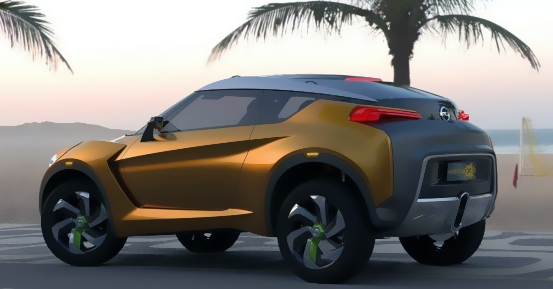
This rough sketch released by Mitsubishi today reveals a new baby 4×4 which the company plans to unveil at the Geneva Motor Show next year.
The new Mitsubishi will use the company’s mid-size platform – used already on the Outlander and Lancer – and will feature the familiar ‘jet-fighter’ front end to bring it in line with other newer models in the Mitsubishi range.
Mitsubishi Motors today announced that it would introduce a new compact crossover model next year. First sales will be in Japan in February 2010.
Although details of the new car are sparse, it seems that this is Mitsubishi’s competitor for Nissan’s hugely influential Qashqai, which pioneered the concept of a Golf-class people carrier/SUV crossover when it was introduced in 2007.
Mitsubishi says that the new car will supports its “strategic shift from being an SUV-focused nameplate to a manufacturer of environment-friendly passenger cars and crossovers”, although it doesn’t look as though it is completely abandoning the SUV market, where its Shogun models have a long-established presence.
Mitsubishi hasn’t yet revealed any details of the new car’s drive-train, so it’s not yet clear whether it will join the recent trend to treating four-wheel drive as an optional extra on SUVs and crossovers rather than as a “must have” feature.
The base engine will be a 136 horsepower 1.8-liter four-cylinder unit churning out 206 pound-feet of torque. It will be mated to Mitsubishi’s Twin Clutch SST gearbox and an all-wheel drive system. The new engine is planned to have class-leading power output courtesy of a high-efficiency turbocharger and high-efficiency combustion characteristics.
October 27th, 2009 — mitsubishi

Mitsubishi Motor Corporation is seeking to make an entry into the already burgeoning Filipino market by introducing new vehicles and increasing the level of visibility in that country. Philippines is a major consumer of automobiles in the region and Osamu Masuko, president of Mitsubishi revealed that Mitsubishi’s market share in the Philippines has increased to 18 percent this year, despite recession.
Mitsubishi can expect a bigger market share in the coming years as new models are being prepared to be launched in the Philippines soon. One of them that will be launched in the coming years, will be the Global Small, a 1.1 liter that will join the entry-level passenger car category. By the end of the year, MMPC will likely introduce another variant to a popular model.
This same Project will be as Ecocar porject in Thailand too.
October 1st, 2009 — Auto show / Motor Show, mitsubishi

WORLD PREMIERE: i-MiEV CARGO
Derived from the production i-MiEV, this concept maximises the outstanding environmental performance and economic efficiency characteristics that define the EV and at the same time adds a generous amount of rear free space to extend the range of uses to which it can be put by corporate users and self-employed operators in particular. The rear space features space-efficient cubic dimensions to allow the user to exercise their imagination fully in adapting it for whatever use he/she chooses. The result is a concept for an EV that meets user needs for a variety of situations: from business use, where maximum payload space is required, to leisure and other individual owner uses.

i-MiEV CARGO (SHOW MODEL)
1. Design
The i-MiEV CARGO’s unique styling was developed around a “joint” design concept as it links the i-MiEV’s curvaceous front section with a square rear end to give the vehicle a distinctive road presence in a wide variety of situations. Inside, the clean and simple styling eliminates extraneous elements and details to improve usability and create an interior space characterised by its free-thinking design and originality.

2. Luggage compartment
Measuring 1350 mm wide by 1180 mm deep and 1100 mm high and having a flat floor, the cube-shaped luggage compartment at the rear of the vehicle allows every inch of available space to be utilised. The height of the compartment floor has been designed to facilitate loading and unloading of luggage and make it more user-friendly.

i-MiEV CARGO SPECIFICATIONS
| Overall length |
3395 mm |
| Overall width |
1475 mm |
| Overall height |
1860 mm |
| Wheelbase |
2550 mm |
| Track F/R |
1310 mm / 1270 mm |
| Occupants |
2 |
| Motor |
Permanent magnet synchronous |
| Max. output |
47 kW |
| Max. torque |
180 Nm |
| Max. cruising range |
160 km |
| Drive train |
Rear wheel drive |
| Tire size |
Front: 145/65R15; Rear: 175/55R15 |
October 1st, 2009 — Auto show / Motor Show, mitsubishi

WORLD PREMIERE: MITSUBISHI CONCEPT PX-MiEV
Powered by the new Mitsubishi Plug-in Hybrid System, which significantly extends the frequency a hybrid vehicle is driven in EV mode, the Mitsubishi Concept-PX* MiEV† returns fuel economy in excess of 50 km/litre. The Mitsubishi Concept PX-MiEV is a new-generation concept car that balances high environmental performance with running performance by utilizing differential motors and Mitsubishi’s all-new S-AWC (Super All Wheel Control), that utilises E-AYC (Electric-powered Active Yaw Control) which transfers torque to the rear left and right wheels. Other features include Mitsubishi’s cocochi-interior**, which provides occupants with a comfortable cabin environment, as well as many of the latest safety technologies.
* PX: Plug-in hybrid crossover. † MiEV: Mitsubishi innovative Electric Vehicle
** “cocochi” is a pun on the Japanese word for “cosy”

1. Design
Solid, Safe, and Simple were the keywords which drove the development of an exterior design suitable for a next-generation crossover that creates simple appearance from which all extraneous elements have been pared and that is free of the “rugged” elements typical in conventional SUVs. The headlamps and rear combination lamps use LED emitters that give the car an innovative and modern appearance as well as delivering better environmental performance with their reduced power consumption. The body uses a newly-developed metal colour that gives the car a metal shell-like appearance. Combining elements of both spoke and dish styling, the road wheel design highlights an unprecedented new look to the body as well improving brake cooling and aerodynamic performance.
The interior was designed to give an image of an airplane cockpit to improve the driver’s concentration, with an instrument panel that envelops the passengers and utilises seats that keep the passengers firmly in place. In addition, the entire instrument panel and door trim utilise soft LED lighting that express the vehicle’s innovation and refinement.
2. Mitsubishi Plug-in Hybrid System
The Mitsubishi Concept PX-MiEV’s front and rear wheels are powered by two permanent magnet synchronous motors and is also fitted with a 1.6L DOHC MIVEC gasoline engine which can power the front wheels as well as work as a generator. In addition, the vehicle comes with the newly-developed Mitsubishi Plug-in Hybrid System in which electronic circuitry automatically switches to the optimum drive mode for different driving conditions and remaining energy in the drive battery to extract maximum efficiency from the electric motors and from the gasoline engine. The Mitsubishi Concept PX-MiEV also utilises the MiEV OS (MiEV Operating System) which selects the optimum drive mode through integrated control of the EV components and the gasoline engine as well as controls optimum electrical charge and output in response to remaining battery energy through constant monitoring of the drive battery. With these, a pleasing, safe, and comfortable ride is achieved while conserving energy. In addition, to maximise effective use of the drive battery, the vehicle is equipped with a power supply mode that allows the use of some battery power to supply domestic appliances or as an emergency power source in the event of a natural disaster.
* EV mode
At low to middle vehicle speeds the Mitsubishi Concept PX-MiEV’s drive battery powers the front motor using front-wheel drive. When driving on snow, in the rain or in other low surface friction situations where maximum vehicle stability is required, the system automatically switches to four-wheel drive mode by feeding power to the rear wheel motor as well when sensors detect any front wheel slip.
* Series hybrid mode
When the remaining energy in the drive battery falls to a predetermined level the system starts the gasoline engine to generate electricity and automatically switches to the series hybrid mode using the electricity generated to power the motors. In this mode as well, the system switches to four-wheel drive by driving the rear motor depending on driving conditions.
* Parallel hybrid mode
At higher vehicle speeds the car is supported by the gasoline engine which operates more efficiently than the electric motors at high revolutions. In this mode, the gasoline engine also helps drive the wheels. When the driver makes sudden lane changes or other manoeuvres requiring greater vehicle stability the system switches to four-wheel drive by bringing in the rear motor to drive the rear wheels, improving stability. In addition when overtaking at higher speeds or in other situations requiring faster acceleration the system switches in both front and rear motors to provide additional power and assist the gasoline engine, providing high acceleration.

* Regenerative mode
When the vehicle is slowing or coasting down a long descending slope the system switches to regenerative mode in which kinetic energy reclaimed from the wheels is stored in the drive battery.
* Charging mode
As with the production i-MiEV, Mitsubishi Concept PX-MiEV features a 3-way battery charging system using either a 100-volt or a 200-volt domestic supply or a high-power quick-charging station. The system also incorporates a Wireless Charging Program feature that allows the owner to start charging the battery or start the air conditioner at a preset time even when away from the vehicle.
* Power supply mode
As a way to maximise the usefulness of the power stored in the drive battery based on the “Smart Grid Framework,” which garners attention as a link in tackling global warming, when not on the road the Mitsubishi Concept PX-MiEV allows the owner to store electricity at night and then use that electricity via the normal charging connector to power home appliances during the daytime when domestic electricity consumption is highest. This allows the drive battery to be used as a power source in the event of a natural disaster. Should the electricity left in the battery fall below a predetermined level, the gasoline engine starts up and works as generator to maintain the power supply at a fixed level.
A 100-volt AC auxiliary socket in the rear luggage compartment also allows the electricity stored in the drive battery to be used to power cooking or lighting equipment and other appliances when camping or engaged in other leisure activities.
Continue reading →
June 5th, 2009 — electric vehicle, mitsubishi

Mitsubishi Motors Corp.’s electric vehicle is twice as expensive as popular hybrid cars by rivals Toyota and Honda, but Japan’s No. 4 automaker said Friday the i-MiEV will help it survive increasingly intense global competition.
“With the electric vehicle, we will challenge global players,” said Mitsubishi Motors President Osamu Masuko at a news conference where the company rolled out the new model.
The i-MiEV is powered solely by electricity, and can be recharged from a regular home socket. The four-seater vehicle can run up to 160 kilometers (100 miles) after charging seven hours at 200 volts.
“It is a zero-emission vehicle. It does not rely on oil, which is different from hybrid cars,” Masuko said. A hybrid car switches between a gas engine and electric motor to boost mileage.
The price tag is also different. Mitsubishi’s i-MiEV costs 4.59 million yen ($47,560), more than twice as much as Toyota Motor Corp.’s new Prius hybrid vehicle, which is just over 2 million yen, or Honda Motor Co.’s Insight, which starts at 1.89 million yen, the cheapest hybrid on the market.
Masuko acknowledged the high price is a major hurdle to encouraging people to buy the i-MiEV, which stands for Mitsubishi innovative electric vehicle. (The initial “i” doesn’t have any particular meaning, the company says.)
“This is not the price that ordinary people can easily buy. But as we increase our production, we aim to cut the price below 2 million yen,” he said without elaborating further.
Masuko noted i-MiEV buyers can receive hefty subsidies and pay no tax under a government program promoting the use of ecological vehicles. With the help of government subsidies, the i-MiEV costs 3.209 million yen, down 43 percent from the original price. The vehicle is also tax-free for three years.
The subsidy program for electric vehicles runs from April to March next year. But an official at the trade ministry said the government plans to extend the program.
Initially, Mitsubishi aims to sell 1,400 units of the i-MiEV to local governments and companies during the current business year through March 2010. Sales to individual consumers in Japan will begin next April.
Masuko said the company had spent more than 40 years to develop the i-MiEV, but declined to say how much the company had invested in its development.
Various automakers are racing to develop electric cars amid rising oil prices and concerns about global warming.
Malaysia’s national car maker Proton and Detroit Electric, a Netherlands-based company plan to make electric cars by early next year. U.S.-based Tesla Motors has a prototype electric car that is scheduled to be produced by 2011.
Toyota said it plans to sell electric vehicles in the U.S. by 2012, while Nissan Motor Co. said it will market electric vehicles in Japan and the U.S. after April 2010.
The company aims to sell 250 units abroad, mainly in Britain and other European countries, in the current financial year. Mitsubishi also plans to sell the i-MiEV in China and the United States, but Masuko gave no details.
Globally, Mitsubishi hopes to sell 15,000 units for the year through March 2012.
But the company can only make a profit on the i-MiEV if it produces 30,000 units per year, Masuko said.
“We want to reach that level as early as possible,” he said without giving further details.
He added that the company is considering making a commercial electric vehicle.
“We are looking ahead. We look at the global auto market of 10 or 20 years later from now,” Masuko said. “We are in the midst of global auto competition, and we should not be left behind.”
Mitsubishi Motors’ share price has jumped recently on hopes for the new car. On Friday, it rose 2.3 percent to close at 175 yen after surging almost 12 percent Thursday.
April 3rd, 2009 — Auto show / Motor Show, mitsubishi

The centerpiece of Mitsubishi Motors’ stand at next week’s New York Auto Show will be the Outlander GT Prototype. Building on the success of the current Outlander, this sporty compact CUV will make its World debut on April 9.

Dressed in a premium Diamond white hue, the Outlander GT Prototype showcases a host of new technologies, such as Idle Neutral Logic that automatically shifts the transmission into neutral during vehicle standstill, improved performance and fuel economy from its more powerful 3.0-liter SOHC MIVEC V6 engine, and a Super-All-Wheel-Control System offering superior handling and control. Additionally, there is a number of exciting design elements that help distinguish the Outlander GT Prototype, including Mitsubishi Lancer Evolution’s signature “Jet Fighter” grille.

February 26th, 2009 — mitsubishi

Mitsubishi Motors Corporation (MMC), in cooperation with its Hong Kong distributor Universal Cars Ltd., today signed a Memorandum of Understanding (MoU) with the Environment Bureau of the Government of the Hong Kong Special Administrative Region of the People’s Republic of China regarding local evaluation of the zero-emissions i MiEV*1 electric vehicle.
As an investigative step toward possible future introduction of the electric vehicle, the proposed project would begin as early as May 2009 and would examine issues including market acceptability, as well as incentives and structural issues such as the suitability of the charging infrastructure.
Announced in October 2006, the i MiEV represents the pinnacle of Mitsubishi Motors’ green technologies. Currently involved in testing and promotional activities in Japan, New Zealand, the United States and across Europe, the i MiEV will be launched in Japan during the summer of 2009.
*1 MiEV: Mitsubishi innovative Electric Vehicle
February 9th, 2009 — mitsubishi

Mitsubishi Motors (Thailand) has proposed that the government relax some requirements of the eco-car project to better suit the sluggish global consumers spending.
According to Takeo Sakurai, Mitsubishi Motors’ corporate general manager, the relaxation of some rules for the small, fuel-efficient vehicles will push forward investment even in face of the global economic slump.
“As we all know, certain manufacturers have announced a review of their eco-car projects as they think committing a lot of money now may not be a good idea. This does not mean that such an investment is impossible — it could be done if the government provides more incentives to the investors,” he said.
Mr Sakurai said minimum annual output and local content figures were the two areas where carmakers with Board of Investment incentives had earlier requested the Industry Ministry make changes. However, the ministry had turned down the proposal.
“Even though we have a very strong intention to produce eco-cars in Thailand, these requirements together with the downturn of economy have forced us to review the investment and put off the timing of the production,” he said.
The global slump has taken its toll on local vehicle production including Mitsubishi, which recently cut its output to 1,100 units a month from 1,800 normally. He expects February’s number to be much worse.
“Close to 90 percent of our production is for the export market, where orders have plunged. Until now, we are still uncertain about the demand in the second quarter, especially in Europe and Africa,” he said.
To adjust to the lower output, Mitsubishi will have to reduce the number of work shifts to only one from two, which could result in terminating the employment of 1,100 sub-contract workers.
“We now employ 3,700 full-time workers. What if the industry sinks even further? I don’t know… We have no plan yet. We just hope things will get better,” he said.
February 4th, 2009 — mitsubishi

Mitsubishi Motors Corporation (MMC) announced today their decision to withdraw from Cross Country Rallying, starting with the legendary Dakar Rally.
In its 26 entries in this event, Mitsubishi Motors won the rally a total of 12 times, including seven consecutive victories. In addition to this unparalleled record the company also gained 4WD technology that informs its production vehicles, most visible in their durability and off road performance.
The sudden deterioration of the global economy made it necessary for the company to focus its resources more tightly, leading to today’s announcement.
January 26th, 2009 — Auto show / Motor Show, mitsubishi

Mitsubishi Motors Corporation is to give the i MiEV SPORT AIR concept model its global debut at the 79th Geneva International Motor Show which runs from March 3 through March 15 at the Geneva Palexpo exhibition and conference complex (opening to the general public on March 5).

The i MiEV SPORT AIR explores the future possibilities for zero-emission vehicles, placing a greater bias on exhilarating driving pleasure. The concept model exemplifies the balance between environmental and dynamic performance implied in the tagline Drive@earth, and highlights the benefits of the Mitsubishi electric vehicle drivetrain:

Powerful, instant torque from a beefed-up electric motor
Stable driving and handling and a low center of gravity, due to the in-floor lithium-ion battery
Zero on-road CO2 emissions
Together, these features along with the car’s “clear cutaway” top allow the driver to enjoy the exhilaration of fresh-air motoring while also highlighting its eco-friendly qualities.